Litigant Portal
A guided legal navigation platform for litigants that courts can deploy under their own name.


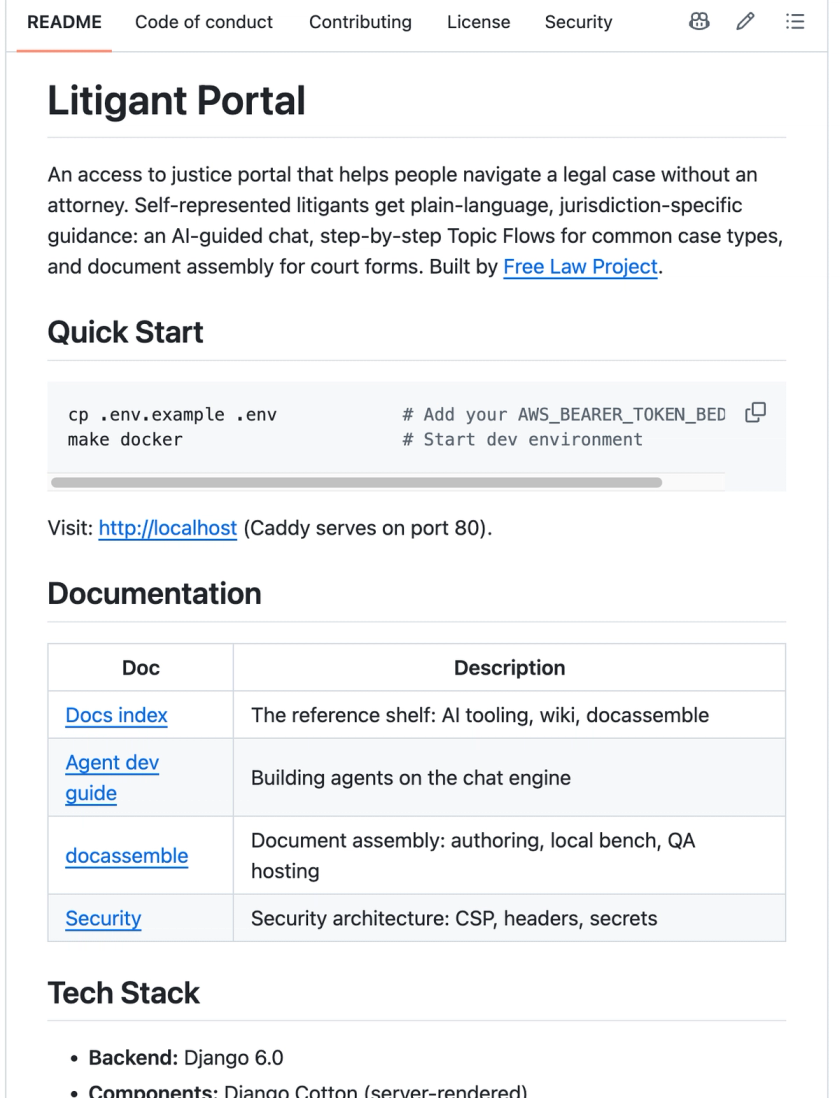
About This Project
Litigant Portal is a guided legal navigation platform for self-represented litigants from Free Law Project. It is white-labeled, so it carries the institutional authority of the court that deploys it.
It provides jurisdiction-specific legal information, guided workflows, and document preparation tools for people in civil matters such as eviction, small claims, and name changes. Courts deploy it in partnership with legal aid organizations, and Free Law Project, a 501(c)(3) nonprofit, builds and maintains it as open-source software under the AGPL-3.0 license.
How it works
The Litigant Portal guides users through their legal matter in three phases: Assess, Prepare, and Act. Users can move through it with or without AI assistance, and both paths draw on the same jurisdiction-specific content configured by the court partner.
- Assess: Users either browse LegalFlows, which are subject areas such as eviction, small claims, or name change, or describe their situation in their own words to Pathfinder, the portal's AI chat. In the chat they can ask questions and upload documents for analysis, and Pathfinder answers from the court-configured content.
- Prepare: Users complete the forms their matter requires through guided interviews, by filling in PDF or paper forms, or with Navigator, the portal's AI document preparation tool. Navigator carries forward the context from the Assess phase and explains each step in plain language.
- Act: The portal shows what comes next, including filing deadlines, courthouse locations and hours, accepted filing methods, and referral to legal aid or an attorney when the matter requires it. Where a court integrates, the portal can connect directly to the court's e-filing system.
Not every deployment includes every option. What is available depends on the forms, interviews, and integrations the court partner has configured.
How courts deploy it
A court points one web address at the app, such as portal.theircourt.gov, and every service runs under that address. The portal is fully self-hostable. Its topic content follows a defined format, so a court can write it by hand, export it from a content management system, or generate it with AI.
The portal is built with Django, PostgreSQL with pgvector, and Redis, and it uses docassemble for document assembly. Its chat engine uses LiteLLM, so it can work with different model providers. The hosted version runs models through AWS Bedrock, with inference kept in the United States.
Status
Free Law Project opened a founding court cohort in 2026.
The project sits inside Free Law Project's Justice Initiatives division.
Read more about it here on FreeLaw's website
JusticeBench lists this project for research and development purposes only. Listing it does not constitute an endorsement, recommendation, or approval by the Stanford Legal Design Lab. See the Terms of Use.