Public Defenders

Public defenders defend people accused of crimes with early investigation, motions, mitigation, and post-conviction advocacy.
More About This Legal Services Area
Public defense is the system of legal services provided to indigent people charged with crimes. Instead of focusing only on broad constitutional principles, public defense is about concrete services that safeguard defendants’ rights in practice. Typical services offered by public defenders include: Early representation: Advising clients at arrest, arraignment, and bail hearings; working to reduce bail or secure release. Case investigation: Gathering facts, interviewing witnesses, reviewing police reports, and consulting experts. Legal advice & counseling: Explaining charges, possible penalties, and legal options in plain language so clients can make informed decisions. Pretrial motions: Filing motions to suppress illegally obtained evidence, dismiss charges, or challenge procedures. Plea negotiation: Advocating for reduced charges or sentences in plea agreements. Trial representation: Cross-examining witnesses, presenting evidence, and defending clients in court. Sentencing advocacy: Presenting mitigating evidence to reduce penalties and promote alternatives to incarceration. Appeals & post-conviction support: Filing appeals, writs, or motions for new trials; seeking sentence reductions or expungements where applicable. Many public defender offices also provide wraparound support services, such as connecting clients with social workers, housing assistance, substance abuse programs, or reentry planning, recognizing that criminal charges are often intertwined with poverty, mental health, and systemic inequities.
LIST (Legal Issues Taxonomy) Code
AI Projects around this Legal Issue
Brief Bank
An AI-assisted brief and motion drafting tool that lets New Jersey public defenders search prior filings, surface relevant law, and assemble first-pass drafts tailored to case facts.
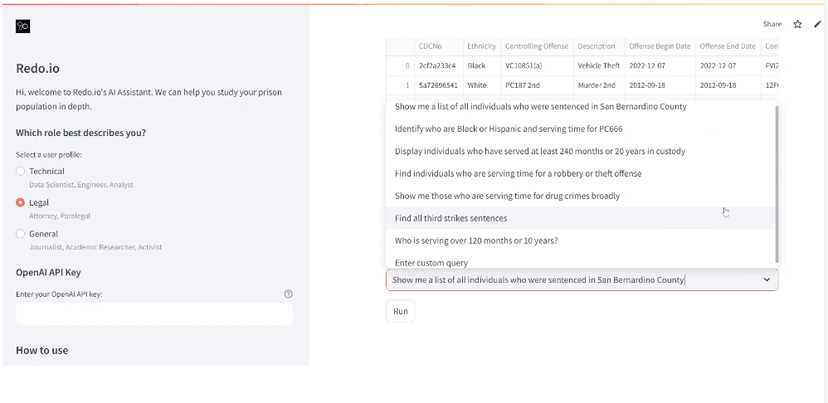
Redo.io
Redo.io is an open-source data and analytics platform that processes roughly 95,000 California prison-sentence records to surface potential sentencing disparities and produce court-ready statistical evidence.