Justice Connect Legal-Problem Classifier
An AI model—developed by Justice Connect with the University of Melbourne—that classifies people’s free-text descriptions of problems into legal issue categories, now available under a no-cost licence to eligible Australian not-for-profits.


About This Project
Justice Connect, in partnership with the University of Melbourne’s School of Computing and Information Systems, has built a natural-language classification model to help people and services correctly identify the legal nature of everyday problems. The model takes a short narrative (typed in plain language) and returns one or more likely legal categories. It was trained on more than 11,000 de-identified help-seeker statements that volunteer lawyers had annotated with areas of law at the span or document level. In current internal testing, the model achieves about 88% accuracy across 12 top-level categories.
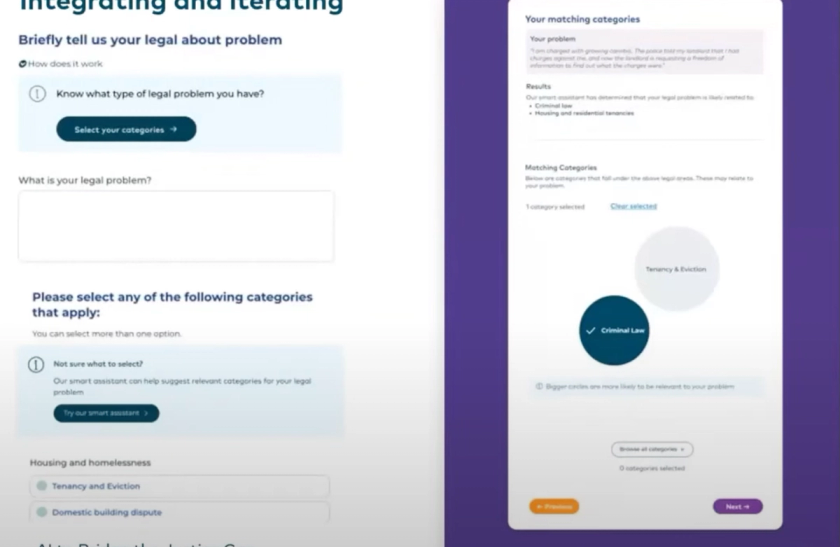
The first production use is inside Justice Connect’s online Intake Tool. Historically, applicants had to choose a category from a list, and many defaulted to “Something else” or selected the wrong area—leading to manual triage and higher rejection rates. After a staged rollout (initially shown to ~30% of users, then to ~50%), the AI-assisted path reduced “Something else” selections from 23% to 9% among those offered the model. The tool still supports a non-AI path, allowing like-for-like comparisons and continued evaluation.
The classifier can be embedded in consumer-facing products (intake forms, self-help guides, service finders, chatbots) and in back-office workflows (intake triage, clinic screening, issue spotting in case reviews, and post-service analysis). Typical outputs include predicted category labels and confidence scores that downstream systems can use to route a matter, suggest resources, or prompt a human check. Because misclassification has real consequences in legal contexts, Justice Connect pairs automation with guardrails: clear disclosures, options to opt out, and human review for edge cases.
Justice Connect is accepting expressions of interest from Australian not-for-profit legal services to use the model under a no-cost licence at Justice Connect’s discretion. Distribution at this stage is “model-only”: organisations should plan their own integration and support. To improve fairness and performance, Justice Connect also invites partners to contribute additional, de-identified language samples—especially from communities typically underserved or at higher risk of NLP bias (e.g., older adults; people with disability, chronic illness, or mental-health conditions; First Nations people; recent migrants; LGBTQIA+ communities; people without tertiary education). Guidance is available to help partners assess privacy and confidentiality considerations before contributing data.
In sum, the model is a practical, evaluated component for legal-help ecosystems: it improves first-touch categorisation, reduces referral “roundabouts,” and creates cleaner inputs for downstream tools and services—while keeping people in control and preserving a path to human judgment.