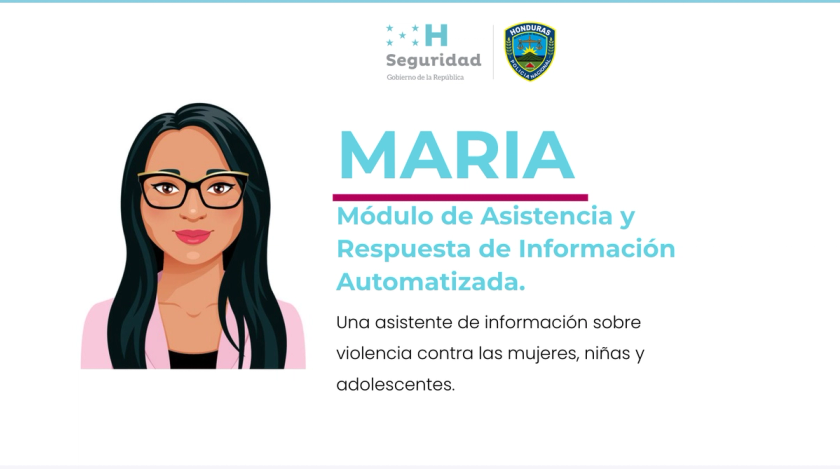
Maria
A free, privacy-preserving AI chatbot from Honduras’ State Secretariat for Security (with UNDP/Infosegura and USAID support) that helps women, girls, and adolescents identify gender-based violence, understand options, and connect to appropriate services, including Linea 114.


About This Project
MARIA is a web-based conversational assistant designed to lower barriers to information and support for people affected by gender-based violence (GBV) in Honduras. Built within the UNDP Infosegura framework in partnership with the State Secretariat for Security and USAID, the tool uses AI/ML classification to interpret a user’s written description of their situation and respond with clear, context-appropriate guidance. It routes users to official resources—such as the national Linea 114 “Mujer Viviendo sin Miedo”—and other relevant institutions for emergency response, legal information, counseling, and safety planning. MARIA is available at all times, at no cost, and is intended both for survivors and for friends or community members seeking to understand and recognize abuse.
The chatbot operates entirely in the browser and does not require downloads or registration; chats are not retained once the page is closed, and personal data are not stored. This privacy posture is meant to reduce risk for users on shared devices. Conversations are conducted in accessible language, with prompts that help users identify types of violence (physical, psychological, economic, workplace harassment, and more) and practical next steps, including when and how to seek urgent help.
Operationally, MARIA is positioned as a complement to—not a replacement for—human services. It functions as a first point of contact that can triage questions, explain rights, and provide verified phone numbers and service pathways, while recognizing that emergencies must be handled by dedicated authorities. Behind the scenes, content and responses are curated and periodically reviewed by specialists so that guidance matches Honduran law, institutional processes, and local terminology.
For institutions, MARIA offers additional benefits: it can help surface service gaps and inform policy through privacy-preserving, aggregate insights (e.g., time and geography of requests, recurring question themes). These data can support territorialized prevention and response strategies, optimize staff time, and strengthen inter-agency coordination across the GBV ecosystem.
As a government-backed, AI-assisted navigator focused on violence against women, girls, and adolescents, MARIA’s goals are straightforward: make trustworthy information easy to access, connect people quickly to appropriate support, and reinforce institutional capacity with timely, anonymized signal on what users need and where.