Legal Org Ops
Admin teams of legal organizations run operations like conflict checks, scheduling, compliance, knowledge management, strategy, and other backend operations so legal teams can deliver excellent, sustainable client services.
More About This Legal Services Area
Legal Ops is the operational backbone of a legal aid or court-help organization. The team translates policy and practice standards into everyday procedures, makes sure staff have reliable tools and templates, and monitors quality, risk, and capacity. Legal Ops connects intake, service delivery, finance, IT, evaluation, and partnerships so the whole program runs consistently across offices, clinics, and channels (walk-in, phone, web, SMS). The aim is predictable, high-quality client services with clear handoffs, auditable records, and continuous improvement. In practice, Legal Ops owns service design (defining pathways for info, brief advice, limited-scope, full representation), documentation (checklists, templates, model pleadings), data architecture (matter fields, LIST issue codes, jurisdictions, outcomes), vendor and technology management (case management, calendaring, e-filing, document assembly, analytics), and change management (training, guidance, and release notes). The team partners with supervising attorneys on practice rules, with IT/security on privacy/PII controls, and with evaluation on metrics and dashboards. Because many A2J programs are distributed and time-sensitive, Legal Ops also maintains “day-of” operations: triage protocols for surges, clinic rosters and scripts, conflict and eligibility rules, deadline calculators, form libraries, and escalation pathways (e.g., safety, immigration, disability, language access). They ensure compliance with grants and court rules, track risks (hallucination/over-automation in AI, link rot, accessibility), and create feedback loops from staff and clients back into training and tools. For AI adoption, Legal Ops acts as product owner: scoping use cases, curating corpora, setting guardrails (information vs. advice, refusals, jurisdiction checks), and defining evaluation rubrics (actionability, on-book fidelity, safety, accessibility, language parity). They coordinate pilots, monitor incident reports, and publish deprecations and updates so field teams can trust the tools.
LIST (Legal Issues Taxonomy) Code
AI Projects around this Legal Issue
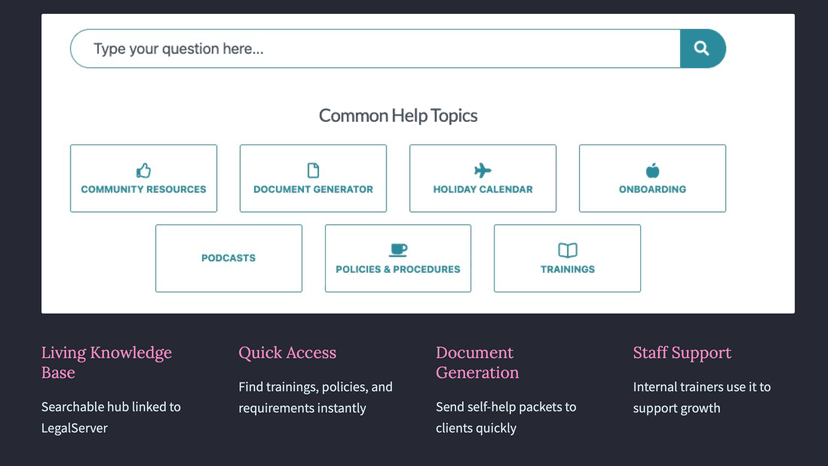
Staff Compass knowledge management system
Legal Aid Society of San Bernardino (LASSB) is piloting “Staff Compass” — a SweetProcess-powered internal knowledge hub that unites policies, procedures, and training for every staff member, no matter where they work.
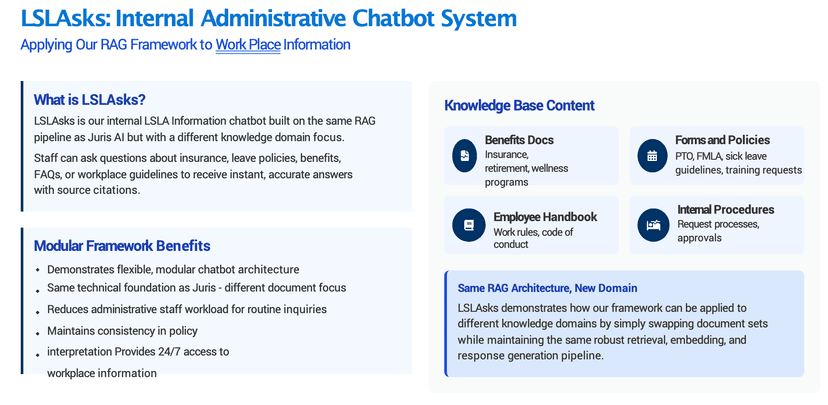
LSLAsks
A chatbot prototype from Lone Star Legal Aid to provide staff with centralized, searchable access to internal policies, benefits information, and workplace procedures.